Entertainment
4 December, 2025
‘Miracles’ is an exhibition of hope
EVERY mum has a pregnancy or birthing story, whether it’s a horror tale of a 20-hour labour, or the perfect natural delivery - it’s a common conversation over battle scars.
But rarely is the anticipation, challenges and wonder of childbirth captured through a personal journey of IVF treatment.
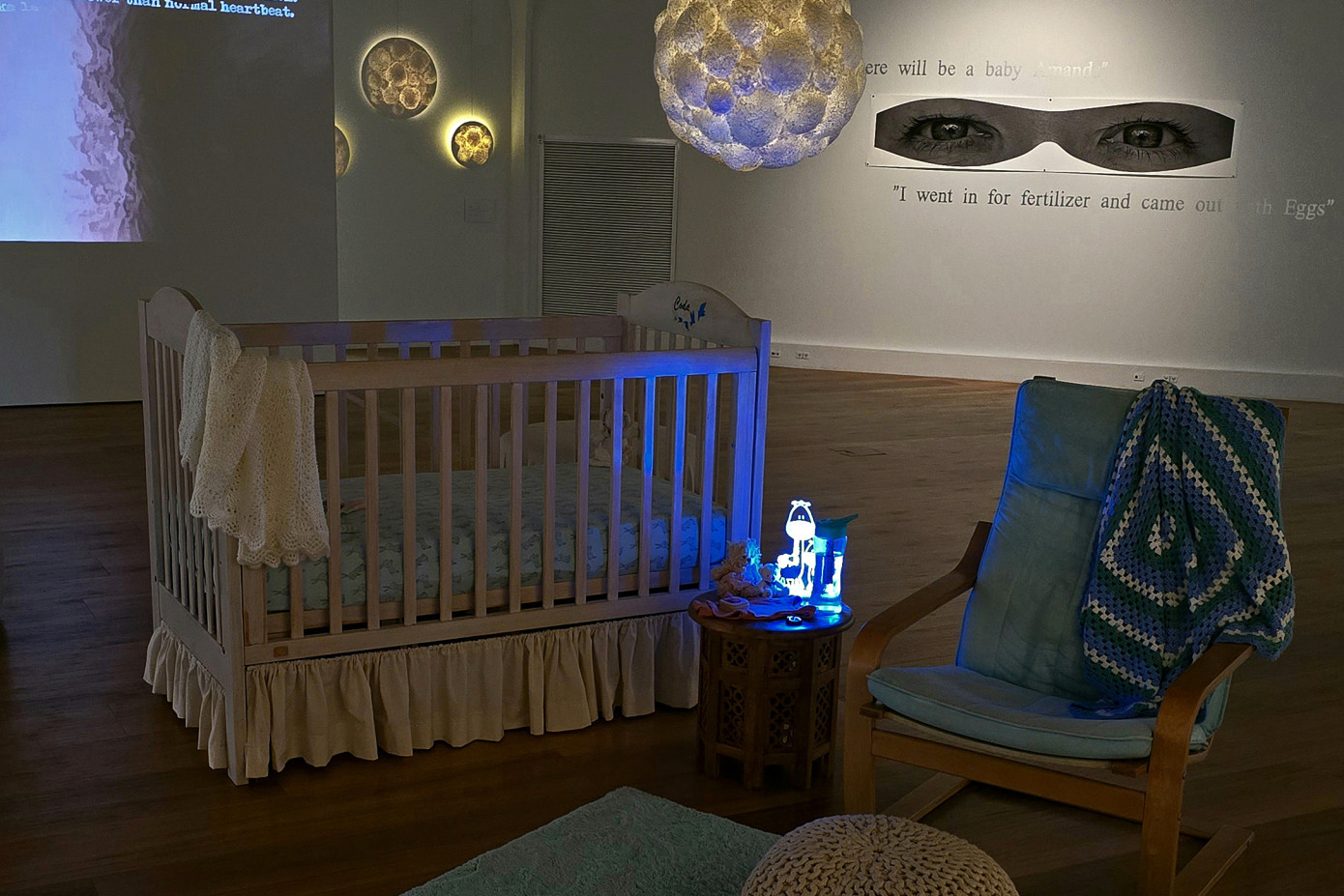
Renowned local artist Amanda Feher has created a moving, fascinating, multi-media exhibition tracing her journey of early-onset menopause, in vitro fertilisation, egg donation and the traumatic moments that peppered her progress to having the beautiful family she and her husband now enjoy.
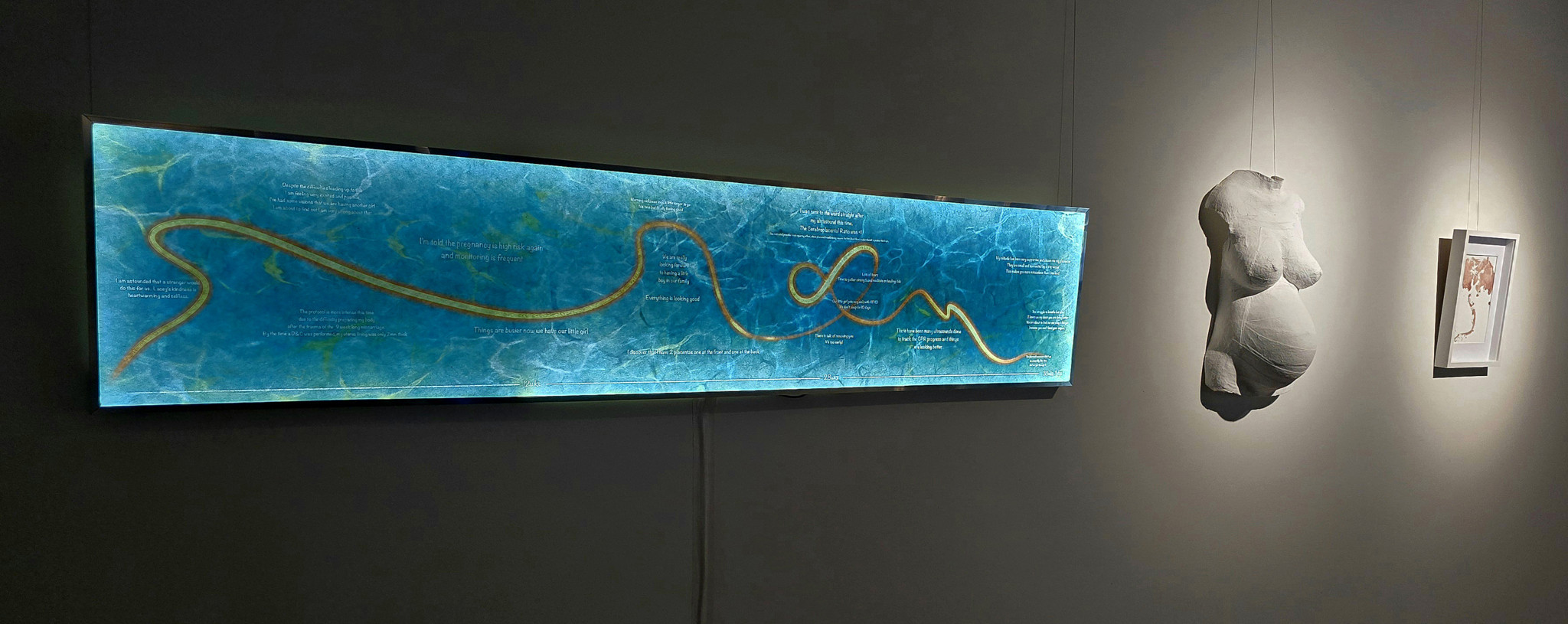
Showing at the Tableland Regional Art Gallery, it’s an all-encompassing art experience, from the “Life Ribbon 1 & 2 abstracts, beautifully coloured with soft backgrounds, which represent a “baby’s-eye view of the womb”, to the joyous family portraits, and extraordinary lighting.
Life Ribbon features a line running through the works, taking on the peaks and troughs of the pregnancy journey. Snippets of text explain what happened at the exact moment on the line.
“The text reflects my experience and feelings at different times in the journey,” she said. “It was my way of understanding.
“The light line represents the umbilical chord and the timeline is represented below.”
In another series of works, Cell Lights, the creations are like “night lights”, their beauty and form “are how we all started as a collection of dividing cells”.
In another eye-catching display, Beautiful Mysteries 1,2,3 - large cloud-like sculptures hang from the roof, representing embryos. They are lit from within, alternating from bright to dull, pulsating like a beating heart.
Running together with the exhibition is Odyssey, a video that visitors are encouraged to watch to add to their understanding of just what went into the creation of this body of work.
It is comprehensive, touching and adds more depth to the exhibition experience. Especially, the remarkable facts around Amanda’s infertility, and the incredible search for eggs.
Amanda’s story began at 30 when she first experienced night sweats. Two years on and she had her first hot flush – and within weeks had been told she had Fragile X, which means one X chromosome multiplied far more than the other, and led to early menopause.
The discovery took her through trials, tribulations, generosity, family bonds, and a chance encounter with a woman over a lawn grass grub – which proved life-changing (and life-giving). But it is too precious a story to give anything further away here.
Anyone familiar with Amanda’s public works would understand the big, bold statements, working together with the softer photographs, music, lighting and paintings.
Born on the Tablelands and with an artistic Hungarian family of portrait and landscape painters on her father’s side, she was supported in her creativity and university studies across various artistic mediums.
Her favourites are working with marble, copper, wax, fibre, bronze, charcoal, digital imagery, and installation. She also has a fascination with stone carving.
All of these mediums arise through her “concept” framework, which is important in understanding the intent and reason behind a work.
Did Amanda fear the concept behind this exhibition could be too much for some, or too triggering for anyone who has been through the challenges of infertility?
“I really had to check my heart space and see whether I would want to open up such a very personal story to the community,” she said.
“My story is unique to my family and in no way compares to the experiences of others. The content may be sensitive for some viewers. Things don’t always work out, and I really feel for those people who have struggled without the success at the end of the long tunnel.”
But Amanda believes art has the power to reach people in a way that is different to other mediums. It has the power to move people.
“I believe I was put on this earth to communicate through art,” she said.
Interestingly, feedback from people who had seen some of the works, and who had never experienced the challenge, was equally strong.
“They said they were more appreciative of what they have and were very moved.”
The exhibition also raises the spectre of the struggle to conceive.
“I feel this conversation needs to happen,” Amanda said firmly.
According to the World Health Organisation, infertility is defined as the inability of a couple to achieve conception after a 12-month period of unprotected intercourse or the inability to carry pregnancies to live births.
One in six Australian couples of reproductive age experience difficulties conceiving a child.
“I want to open this to the community, to enlighten people and to bring hope,” Amanda said.
“When you are told everything is really, really bad, there is still a possibility. We were told the worst scenarios, but we felt calm; we embraced the journey.”
In her hope to provide hope, and in her care for those who attend the exhibition, Amanda has provided a feedback station as people leave.
“I have two boxes, a release box, where people who may be triggered can write their feelings down.
“That box will be locked and never opened. At the end of the exhibition, I am burning it to release those feelings,” she said.
“The other box, a message box, is also for feedback, shared stories, and for those who want to connect in a different way.”
Miracles by Amanda Feher was opened by Amanda’s daughter Cadence together with former politician Warren Entsch on Friday and will run until 17 January at the Tableland Regional Gallery, 16 Robert Street, Atherton.
WARNING: This exhibition contains themes that may be sensitive for some viewers. Parental guidance is recommended for those under 16. If this exhibition raises any concerns for yourself or someone you know please contact lifeline on 131114.